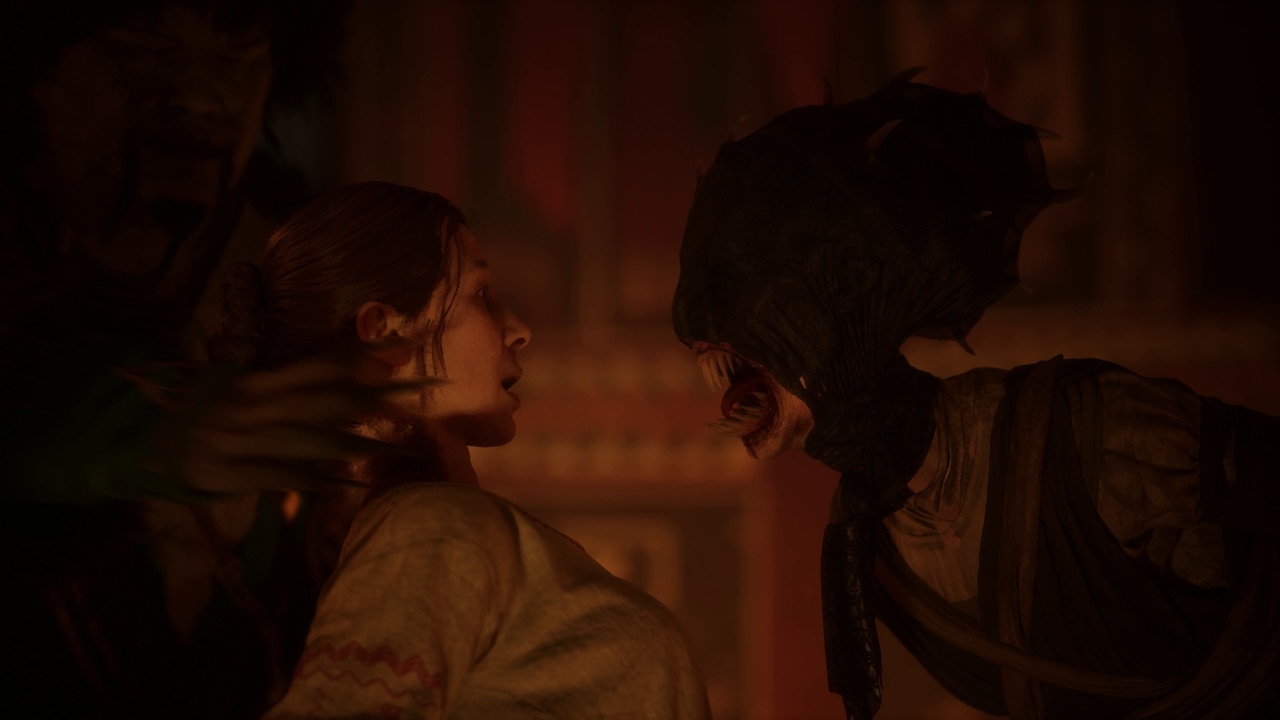
How do choices and consequences work?
The game treats choice as a combination of action, inaction and resource allocation. Coen has thirty days and nights before Brencis plans to sacrifice his family, and many meaningful activities consume visible time segments. Helping one person may therefore mean postponing or abandoning another opportunity even when neither quest offers a simple good-or-evil button.
The world is designed to continue after loss. Official previews show NPC deaths and failed interventions becoming part of the story instead of forcing a reload, while developers say reaching the end of the thirty days has consequences rather than automatically causing game over. That structure supports different routes, but it does not prove that every named character, quest or ending can survive every combination.
Action and inaction are both recorded
Official descriptions repeatedly state that every action—and inaction—shapes the world. You can accept several objectives, ignore a request, observe before intervening or head toward Brencis once the story allows it. The absence of a decision prompt does not mean the situation is neutral; time spent elsewhere can become the decision.
The July PlayStation feature illustrates this design before the open world fully begins. Coen can speak with family, search for villagers, investigate a stolen tapestry, look for a pig or uncover resistance activity, but sunset eventually brings an event he cannot stop. The example establishes a principle: agency exists inside a world where other characters and fixed pressures also have momentum.
Time cost is part of every major choice
Activities that advance narrative time use an hourglass indicator and show a cost. Sources name some quest stages, dialogue choices, skill learning and changing between day and night as possible costs. Wandering, listening and investigating do not make the sun move on their own, so players can gather context before committing rather than answer under a real-time countdown.
That makes route planning a values question as much as an efficiency puzzle. A quest may offer an ally, clue, moral obligation or personal story instead of the mathematically best reward. Because the developers say most—but not necessarily all—content can fit before the deadline, a completionist should expect trade-offs and use manual saves without assuming one perfect route exists.
Day and night can change available options
Coen is human by day and vampire by night, and each form changes more than combat. Different NPCs and quests can be available at particular times; human witchcraft and social access may solve one problem, while vampire senses and vertical traversal reveal another path. Changing phase can itself spend time, so returning at night is a strategic choice rather than a free menu toggle.
The cathedral demonstration is a clear example without proving a universal rule. Coen identifies a clue during the day but needs his vampire movement to reach it at night, where a confrontation unfolds. Other objectives may have only one window, several solutions or no consequence for phase. The safe reading is that day and night expand the decision space, not that every quest has a mirrored pair of outcomes.
NPC and quest consequences shown before release
A PlayStation studio preview describes Coen choosing whether to gather medicine for his mother and help a villager named Gremla. The later black mass reflects unattended problems with character deaths, and the campaign continues. Another early story offers several responses after returning a villager's pig: participate in the intended slaughter, refuse or buy the animal if Coen has enough money.
Blood Hunger creates a more systemic risk. At a critical low state, ordinary dialogue options can be replaced by an irresistible command to feed, potentially killing someone important. Feeding on animals or taking less blood may reduce one kind of consequence, but the preview does not provide a complete morality table. Allies can also have their own motives, and developers warn that some may betray Coen.
Missable quests and completing everything
The publisher explicitly says Coen will not have time for everyone, while developers told PlayStation that a majority of the game can be completed before time runs out. Those statements are compatible: substantial exploration is possible, but the design still asks players to leave some opportunities unresolved or experience different versions across playthroughs.
Until the retail build can be mapped, there is no verified list of point-of-no-return warnings, mutually exclusive quests, permanently missable equipment or the maximum completion percentage in one run. Treat visible time costs, day/night availability and explicit urgency as signals. Keep rotating manual saves before expensive actions instead of trusting a pre-launch '100 percent route.'
Endings, Brencis and Coen's family
Developers have confirmed multiple endings and multiple solutions within the narrative sandbox. Once Coen reaches a certain point, he can attempt to confront Brencis directly, although doing so without preparation creates a much sharper challenge. Saving family, pursuing revenge, building alliances and discovering secrets are presented as competing motivations that can shape the route toward the conclusion.
The exact number of endings, ending requirements and survival combinations have intentionally not been disclosed in the sources used here. It is also unsafe to assume that expiration of the deadline maps to a single bad ending: the game director says there are consequences and the story moves on. Any named ending or precise family outcome published before verification should be treated as a spoiler claim requiring evidence.
What remains unverified before launch
The framework is confirmed; the decision database is not. To keep this article useful without manufacturing SEO answers, specific outcomes will only be added after they can be reproduced in the final game and connected to a save state, phase, prerequisite and time cost.
- Exact approval, reputation or hidden relationship values, if any.
- A complete list of timed quests, missable rewards and mutually exclusive objectives.
- The exact number, names and unlock conditions of endings.
- Whether New Game Plus or another mode carries choices into a later run.
Frequently Asked Questions
Do choices matter in The Blood of Dawnwalker?
Yes. Official material says actions and inaction shape the world, with quest, time, hunger and day/night decisions capable of changing later events.
Can characters die if I ignore a quest?
Official previews show unattended objectives contributing to NPC deaths while the story continues. That example does not establish the outcome of every quest.
Can I complete every quest in one playthrough?
The developer says a majority of the game can fit before the deadline, while the publisher says you will not have time for everyone. A verified all-content route is not available before launch.
How many endings does The Blood of Dawnwalker have?
Multiple endings are confirmed, but the exact number and unlock conditions have not been disclosed in the sources checked for this guide.
Does running out of 30 days cause game over?
Not automatically according to the game director. Reaching the deadline has consequences, but the game can move forward. The exact outcome still depends on the final game and your route.
Sources & Further Reading
This guide separates official statements from hands-on preview observations. Details that still require release-build verification are identified in the text.
- The Blood of Dawnwalker — Official Game WebsiteRebel Wolves / Bandai Namco Entertainment
- Choices and consequences in The Blood of DawnwalkerPlayStation Blog · 2026-04-28
- Unique time-driven quest system and player choice detailedPlayStation Blog / Bandai Namco Entertainment Europe · 2026-07-07
- The Blood of Dawnwalker — Gameplay Reveal RecapBandai Namco Entertainment Europe
- The Blood of Dawnwalker: Dead and Loving ItXbox Wire · 2026-07-07